Iran, Business, and Survival: A Hungarian Woman’s Story Amidst the Chaos
When a massive port explosion destroyed 15 of my export containers overnight, I learned what supply chain resilience really means. Discover the raw reality of MENA trade logistics, international risk management, and how to rebuild after a crisis.
BUSINESSIRANBLOG
5/22/2025
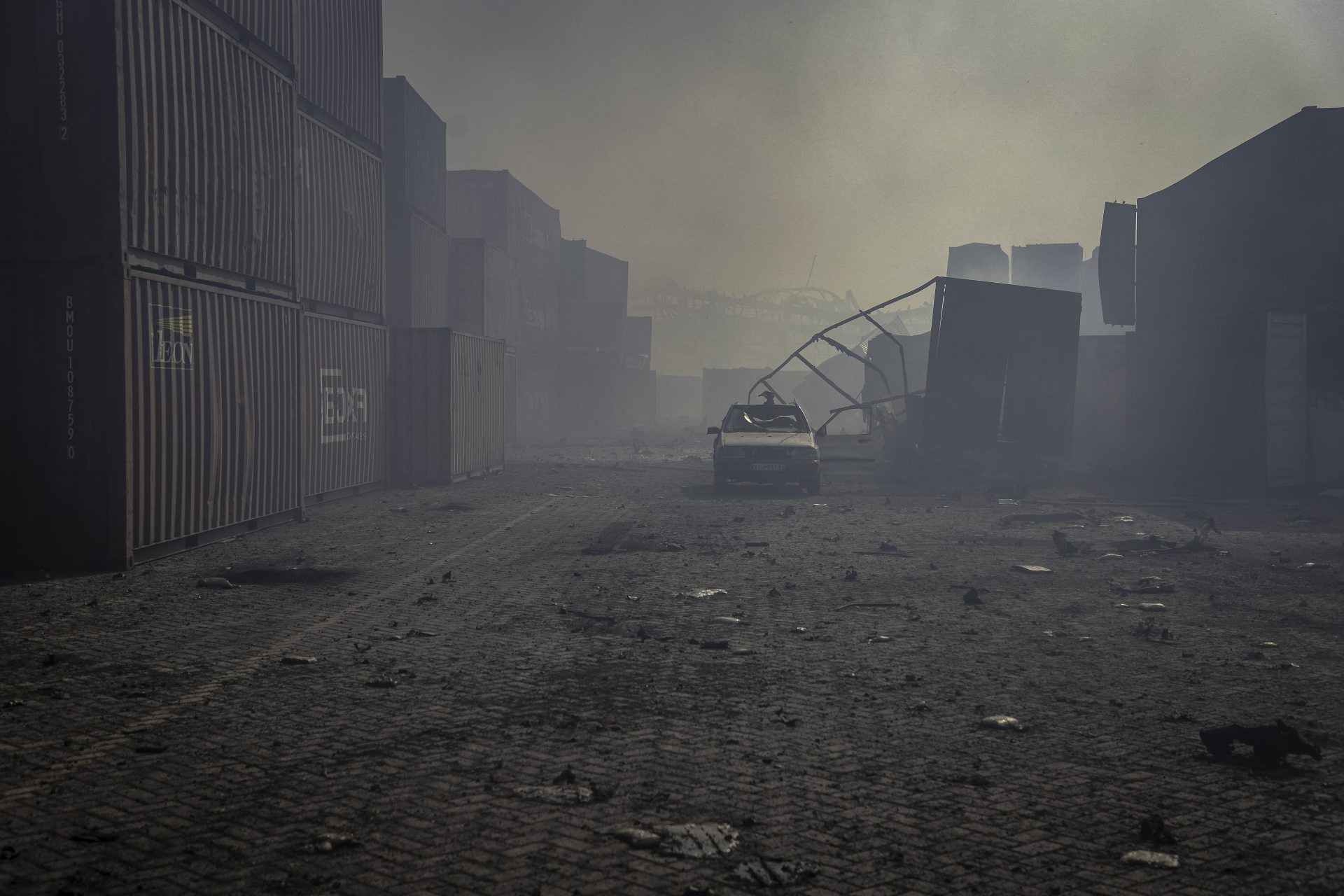
Bandar Abbas. An explosion. Flames. 6,000 containers. 57 dead. Over a thousand injured. And there I was, sitting by the window of a café in Budapest, pondering how to optimize our export strategy for the next quarter. I won’t say there weren’t warning signs, but disasters rarely give you a heads-up. I didn't get the news from CNN; it came as a shaky, cellphone video via WhatsApp, in Persian. Then another one. More flames, more smoke, more question marks. “Where is this?” I texted back. “Bandar,” came the reply. To be precise: Shahid Rajaee Port—Iran’s biggest maritime gateway, handling 85 to 90 percent of the country’s container traffic. And right there, sitting in the port, were 15 of my containers, packed with Iranian-made polymers, en route to a third country.
On April 26th, at noon, a massive explosion rocked the port. The Iranian state media kept completely quiet, but videos, audio recordings, and speculations spread like wildfire on social media. Ammonium perchlorate, rocket fuel, human error, sabotage, an overloaded loading zone—everyone was saying something different, but nobody knew for sure. The reality was probably somewhere between the speculation and the silence. The damage topped 5 billion dollars, the port shut down for days, and Iran’s import-export business just froze.
My spring trade strategy literally went up in smoke. Most of my fifteen containers were consumed by the flames, and what was left looked more like a failed science experiment. These Iranian polymers were moving through triangular trade—a standard method in the region because, frankly, it’s the only way logistics can actually work here. To an outsider, Iran’s market might seem closed off and opaque, but on an industrial level, it holds massive opportunities. But a disaster of this scale can wipe out months of hard work in a matter of seconds.
As for me, I’ve been living in Iran for seven years. I originally came here to study on a scholarship, driven by curiosity and a healthy dose of idealism. When others packed up and went home after graduation, I stayed. Not out of a thirst for adventure or sheer defiance, but because I truly believed that you can build something here that you just can't anywhere else. As a Hungarian woman and a European making a stand in heavy industry in Iran, I’m a rarity—practically a statistical anomaly. I work in a country where, at the negotiation table, the client will often look directly at the man sitting next to me, assuming he's the decision-maker. When it clicks that it’s actually me, the room goes quiet, and the looks on their faces are pure surprise.
There is no predictability here. A deal doesn’t start with a formal proposal; it starts around the fourth cup of tea. "Tomorrow" is more of a vibe than an actual time on the clock. Contracts exist on paper, but the real agreement is born in gestures, eye contact, and the silences. Relationships are worth way more than legal clauses. There’s no daily routine; instead, you’re on constant standby. Strangely enough, this didn’t scare me off—it shaped me. Where there’s no floor, there’s no ceiling either. Where there is no path laid out for you, you have to hack it out yourself. If you adapt here, you learn intuition, rapid situational awareness, and real survival skills.
The Middle East is not a place for the comfortable. It’s an intuition-driven, improvisational world built on networks of relationships. Adaptation, not optimization, is the key to success. I’ve had customs officers vanish into thin air with my paperwork, and containers sit at the edge of the desert for weeks because of a single typo on a form. These uncertainties are just part of doing business. But this explosion was different. This wasn’t an administrative hiccup or a system failure; it was a real, raw human tragedy. It was the kind of event that made even my highly experienced Iranian partner say, "Sometimes, life just rearranges things."
The blast didn’t just hit the cargo; it hit our liquidity, meaning our financial planning had to be completely rethought. Now, I’m working to offset the losses from different angles: shifting investments, setting up parallel trade legs, and restructuring. This isn't some sensationalized story; it's just reality. It’s like playing a video game where you're making great progress, upgrading all your gear, and suddenly there's a power outage—and you forgot to save. Except this wasn't a glitch. It was an explosion. Real, loud, smoky, and final.
And yet, even this couldn’t deter me. Iran—with all its challenges—remains one of the most complex and exciting markets in the world to me. I’ve traveled all over, from Egypt to Uzbekistan, but I’ve never encountered an environment this intense, this raw, and so full of genuine challenges. Nothing comes easy here. Behind every single success, there is hard work, vigilance, compromise, resourcefulness, and sometimes just pure grit. But when you finally achieve something, the feeling is unmatched. There is no autopilot, no luck—only what you truly fought for. This market is unpredictable and the system is fickle, but that is exactly where the potential lies. There is no safety net, no comfortable middle ground—only sharp turns and steep climbs. Win here, and you win big. Lose, and you lose a lot. Because where everything is uncertain, anything is possible.
People often ask me if I’m going to stay. My answer is a definitive yes. I’m staying because in this region, stepping back is not an option—you only pivot and replan. Different port, different partner, different product. What you lose, you can’t always replace, but you can always learn from it. And if you learn, you can rebuild. This market has taken a lot from me, but it has given me even more: experience, a network, flexibility, and a deep, under-the-skin alertness that you just can't acquire anywhere else quite like you can here in the Middle East. Since then, the new shipments are already on their way. Not the same product, not the same route, but the momentum and the drive remain. You can't stop here. And I don’t want to.
There’s a reason Churchill’s words stand the test of time: "If you're going through hell, keep going." Because once you've hit the lowest point, there’s no turning back. The only way from there is forward. New life sprouts from the ashes, and every hardship carries a new opportunity. That’s how loss becomes a lesson, how failures turn into fuel—and that’s how you hold onto what really matters: the belief that there is always a next chapter.
PUBLISHED IN
ÖT: https://ot.hu/ujvari-barbara/iran-uzlet-es-tuleles-egy-magyar-no-tortenete-a-kaosz-kozepen/